Fiber optic cabling carries more bandwidth, farther, with no electrical interference. Dave’s Home Theater designs, installs, terminates and tests single-mode and multimode fiber for businesses, campuses, warehouses, churches, multi-building properties and large homes across Los Angeles County, Orange County and the Inland Empire. California licensed low-voltage contractor #909750.
Fiber optic installation services
Why fiber is worth it
- Distance: copper Ethernet stops at 100 m (328 ft). Multimode fiber runs hundreds of meters and single-mode runs kilometers.
- Bandwidth and room to grow: the same fiber that runs 10 Gbps today can carry 40, 100 Gbps and more later by changing only the optics at each end.
- No interference: light isn’t affected by motors, elevators, lighting ballasts, power lines or radio noise, so the link stays clean in warehouses, plants and busy buildings.
- Lightning and ground protection: glass doesn’t conduct electricity, so fiber between buildings blocks lightning surges and ground loops that damage switches.
- Security: fiber doesn’t radiate a signal and is very hard to tap without being noticed.
- Thin and light: one small cable holds 6, 12, 24 or more strands, saving space in conduit and trays.
Multimode vs single-mode fiber
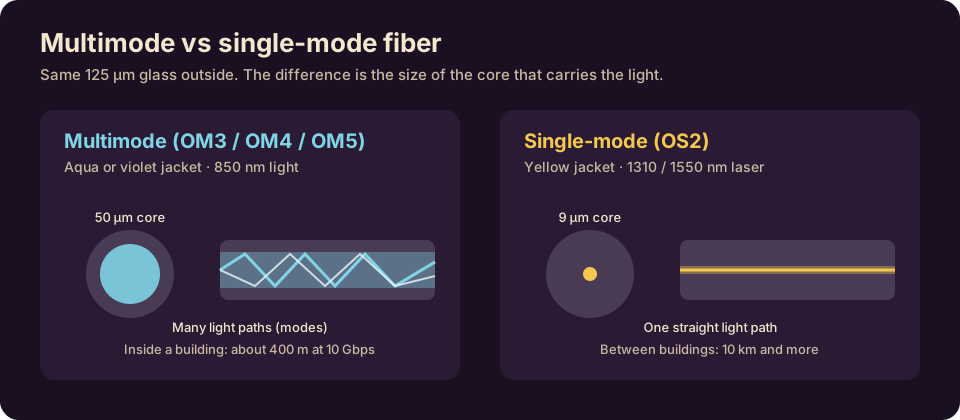
Both types use the same 125 µm glass. Multimode has a wide 50 µm core and uses lower-cost 850 nm optics, which makes it the economical choice inside a building. Single-mode has a tiny 9 µm core and uses lasers, so the light travels in one straight path with far less loss, which is why it is used between buildings and by internet providers.
| Multimode (OM3 / OM4 / OM5) | Single-mode (OS2) | |
|---|---|---|
| Core size | 50 µm | 9 µm |
| Light source | 850 nm VCSEL (lower-cost optics) | 1310 / 1550 nm laser |
| 10 Gbps distance | About 300 m on OM3, 400 m on OM4 | 10 km (and 40 km with extended optics) |
| 100 Gbps distance | About 70 m on OM3, 100 m on OM4 | 10 km and more |
| Jacket color | Aqua (OM3/OM4), violet (some OM4), lime (OM5) | Yellow |
| Best for | Data rooms, backbones inside one building, short high-speed links | Building-to-building, campuses, long runs, ISP connections |
| Advantages | Lower cost per link for short distances, easy to work with | Nearly unlimited distance, the most future-proof for higher speeds |
Not sure which you need? For a run inside one building under a few hundred meters, multimode OM4 is usually the best value. For anything between buildings or longer than about 400 m, or if you want the most headroom for future speeds, we recommend single-mode OS2. We’ll confirm after a site survey.
How a fiber project runs
- Site survey. We walk the route, check conduit and pathways, and measure distances between rooms and buildings.
- Design and quote. Fiber type, strand count, connectors, enclosures and pathway, with one written price.
- Install. Pull or blow the fiber, mount enclosures, and fusion-splice or terminate every strand.
- Test. Loss-test every strand and OTDR-test long runs, then label both ends.
- Connect and hand off. Install the optics, light up your switches and firewall, and give you the test report.
Fiber installation across Southern California
We install fiber throughout Los Angeles County (Los Angeles, Long Beach, Torrance, Pasadena, Burbank, Santa Clarita and the San Fernando Valley), Orange County (Irvine, Anaheim, Santa Ana, Huntington Beach, Newport Beach, Costa Mesa, Fullerton and Mission Viejo) and the Inland Empire (Riverside, San Bernardino, Ontario, Rancho Cucamonga, Corona, Temecula, Fontana and Chino). Most site surveys can be scheduled within a few days.
Questions we get asked
Should I use multimode or single-mode fiber?
Multimode (OM4) is usually the best value for runs inside one building up to a few hundred meters. Single-mode (OS2) is best between buildings, for long runs and for the most future-proof speeds.
How far can fiber run?
At 10 Gbps, multimode OM4 runs about 400 m (1,300 ft) and single-mode runs 10 km (over 6 miles) or more. Copper Ethernet is limited to 100 m (328 ft).
Do you test the fiber after installation?
Yes. Every strand is loss-tested and long runs are OTDR-tested, and you receive the test results with the job.
Can you run fiber between buildings or to a gate or guest house?
Yes. We install fiber in underground conduit, direct-burial or aerial between buildings, and it also protects your network from lightning and ground surges.
Do you install fiber in Los Angeles, Orange County and the Inland Empire?
Yes. We serve all of Los Angeles County, Orange County, Riverside County and San Bernardino County.
Can my existing switches use fiber?
Most business switches have SFP or SFP+ ports. We match the optics to your switches and fiber type, or recommend a switch upgrade if needed.
See also: networking and Wi-Fi, Cat5e and Cat6 network cabling, Cisco Meraki and structured cabling and prewire.
Planning a fiber run? Call 1-800-715-4958 or request a free quote. California licensed contractor #909750, insured and bonded.